It seems that a week cannot pass without some story in the news that expresses concern about Artificial Intelligence. Yesterday 8/8/26, an essay in The Guardian by Kathrine Rundell, “Why I Hate What A.I. Is Doing to The Mind and Happiness of The Young” describes the harm A.I. is already inflicting on students in schools and universities. Her opening paragraph highlights the political danger this innovation could impose:
“If you set out to design from scratch a tool to facilitate authoritarian rule, it would look exactly like AI. You would cherish it for its ability to destabilise our shared reality and its creation of disinformation on a scale unprecedented in human history. With it you need no armies of typists and artists to spread your propaganda. It can enable mass surveillance and thereby put shackles on those who seek to resist you. Its lethal autonomous weapons systems can perfect and normalise remote killing. It will turbocharge inequality; it is already facilitating a breathtaking shift of power and wealth from the hands of the many to the hands of a tiny number of men who – to put it in terms for which I can’t be sued – seem to hold dangerously damaged views about the value and dignity of human life”
The claims she makes are not hyperbole or new. In 2023, Elon Musk stated that A.I. “has the potential of civilization destruction” and called for a six month pause in its development. Musk has modified his view and believes A.I. will likely lead to economic abundance and unlimited leisure time for humanity. So, even if A.I. might pose a risk, it also could offer untold benefits and therefore his “message” is one of optimism. But Rundell’s persuasive argument, along with an MIT study citing the risks from A.I., articles reporting A.I. escaping human control, and the godfather of A.I. Geoffrey Hinton warning that A.I. could lead to human extinction, should wake up everyone to the danger that might be approaching.
One A.I. investor has assured the world that not only are fears about A.I. overblown, but A.I. will be the greatest benefit humanity has ever experienced. In his June 6, 2023, post, venture capitalist and former software engineer Marc Andressenn of Silicon Valley dismisses the notion that Artificial Intelligence poses any threat and proclaims that it will save the world:
“The era of Artificial Intelligence is here, and boy are people freaking out.
Fortunately, I am here to bring the good news: AI will not destroy the world, and in fact may save it.”
Judging from the evangelical enthusiasm of his opening sentences, Andreessen comes across as a true believer in the beneficial potential of A.I. In fact, he offers with prophetic confidence several examples of what A.I. has in store for us. Two such examples are:
“Every child will have an AI tutor that is infinitely patient, infinitely compassionate, infinitely knowledgeable, infinitely helpful. The AI tutor will be by each child’s side every step of their [sic] development, helping them maximize their potential with the machine version of infinite love.”
“Every person will have an AI assistant/coach/mentor/trainer/advisor/therapist that is infinitely patient, infinitely compassionate, infinitely knowledgeable, and infinitely helpful. The AI assistant will be present through all of life’s opportunities and challenges, maximizing every person’s outcomes.”
This vision is utopian fantasy and quite creepy.
Will Artificial Intelligence bring on the apocalypse as predicted by the very men who created it? Or will it usher in the Edenic abundance Musk thinks it will?
A poem that is too frequently exploited to prophesy apocalyptic visions but, in this case, apropos to what might be coming is Yeats’s The Second Coming.
The Second Coming
Turning and turning in the widening gyre
The falcon cannot hear the falconer;
Things fall apart; the centre cannot hold;
Mere anarchy is loosed upon the world,
The blood-dimmed tide is loosed, and everywhere
The ceremony of innocence is drowned;
The best lack all conviction, while the worst
Are full of passionate intensity.

Surely some revelation is at hand;
Surely the Second Coming is at hand.
The Second Coming! Hardly are those words out
When a vast image out of Spiritus Mundi
Troubles my sight: somewhere in sands of the desert
A shape with lion body and the head of a man,
A gaze blank and pitiless as the sun,
Is moving its slow thighs, while all about it
Reel shadows of the indignant desert birds.
The darkness drops again; but now I know
That twenty centuries of stony sleep
Were vexed to nightmare by a rocking cradle,
And what rough beast, its hour come round at last,
Slouches towards Bethlehem to be born?
“The Second Coming” was written in1919. On Yeats’s mind at the time was the horrific slaughter of WW I, the murderous violence of the Russian Revolution and the indiscriminate bloodshed of the Irish war for independence. These events and Yeats’s curious philosophy regarding the cycles of human history forged in his imagination the imagery and symbolism of the poem. The first line, “Turning and turning in a widening gyre” introduces the symbolic cone shaped figure that depicts the geometric rendering of Yeats’s vision of historical epochs. Yeats viewed the course of history as two interpenetrating “gyres”—cones:
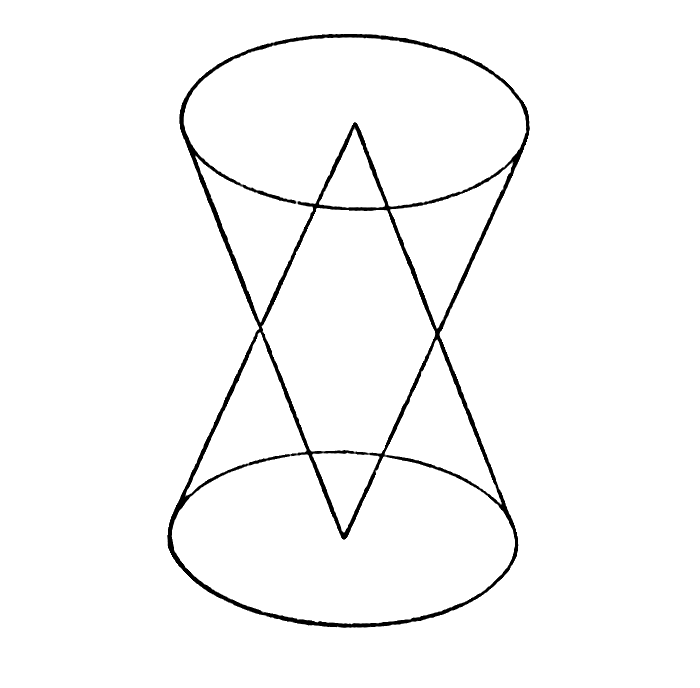
Each one symbolizes a two-thousand-year epoch of human history. As the twentieth century moved forward, Yeats believed that the two-thousand-year Christian cycle was ending and its opposite or antithetical historical period was beginning. Though Yeats knew the history of the Christian era was particularly bloody, he felt the era about to supersede it was even more terrifying.
The terrifying reality foreseen is laid out in the poem in two distinct stanzas, the first eight lines long and the second fourteen. After the symbolic gyre in stanza 1, Yeats introduces in line 2 a metaphor suggesting loss of control: “The falcon cannot hear the falconer.” Then, a succession of metaphors follows that, though frightening, seem rather abstract:
Things fall apart”; “the centre cannot hold;
Mere anarchy is loosed upon the world;
The blood-dimmed tide is loosed, and everywhere
The ceremony of innocence is drowned;
The best lack all conviction, while the worst
Are full of passionate intensity.
These abstract metaphors quickly give way to the menacing images that rise up in the next fourteen lines. And the speaker slides from an objective tone to a subjective, personal one. Lines 9, 10 and 11 pulsate with fear as Yeats repeats words and phrases:
Surely some revelation is at hand;
Surely the Second Coming is at hand.
The Second Coming!
That fear is manifestly justified “When a vast image out of Spiritus Mundi / Troubles my sight.” “Spiritus Mundi” is ‘spirit of the world’ an idea of the collective soul and cultural memories from all societies. From this storehouse of memories comes not the return of Christ; instead, “A shape with lion body and the head of a man, / A gaze blank and pitiless as the sun” appears. This image of a sphinx, dormant for “twenty centuries of stony sleep,” is a beast coming to replace the Christian God. The image suggests a return of pagan gods, perhaps Egyptian ones. But Yeats obscures what it is by ending the poem with a question:
And what rough beast, its hour come round at last,
Slouches towards Bethlehem to be born?
All he knows, “but now I know,” is “some rough beat” that will no doubt endanger humanity is approaching and there is nothing that can stop its progress. The same can be said for A.I. As for the A.I. cheerleaders above, they should read carefully and consider Yeats's awesome poem.
No comments:
Post a Comment